Why Your Meta Ads Aren’t Generating Quality Leads (And How to Fix It)
You’re spending money on Facebook and Instagram ads. Your campaigns are running, impressions are increasing, and leads are coming in. But when your sales team contacts those leads, the response is disappointing.
Some people don’t answer their phones. Others don’t remember filling out a form. A few are interested but have no intention of buying. Meanwhile, your advertising budget keeps getting spent.
Sound familiar?
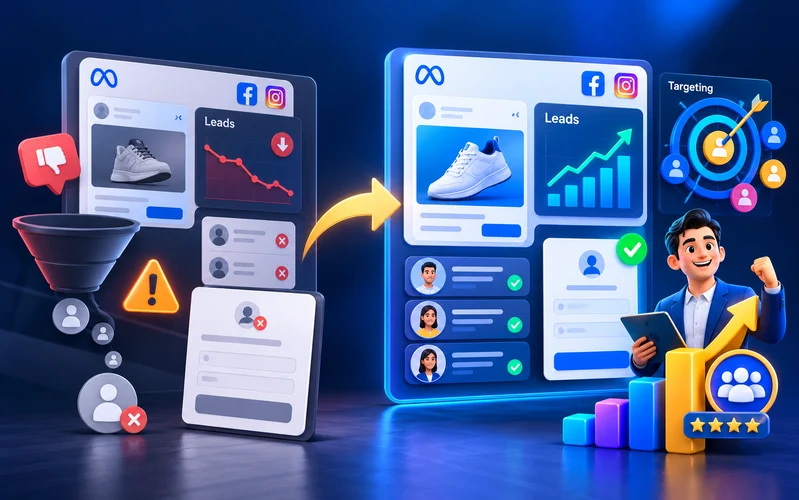
If your Meta Ads are generating poor-quality leads, the problem could be your campaign objective, audience, ad creative, lead form, landing page or follow-up process. A low cost per lead doesn’t necessarily mean your advertising is profitable. What matters is how many leads become qualified prospects and, ultimately, paying customers.
Here’s how to identify what’s going wrong and improve the quality of leads from your Meta Ads campaigns.
1. You’re Optimizing for Cheap Leads Instead of Quality Leads
One of the most common mistakes businesses make is treating cost per lead (CPL) as the primary measure of success.
For example, consider two campaigns:
| Metric | Campaign A | Campaign B |
|---|---|---|
| Ad spend | $500 | $500 |
| Total leads | 100 | 40 |
| Cost per lead | $5 | $12.50 |
| Qualified leads | 10 | 20 |
| Cost per qualified lead | $50 | $25 |
Campaign A looks more attractive because it generates leads at just $5 each. However, Campaign B produces twice as many qualified leads for the same advertising budget.
This is why focusing exclusively on CPL can lead to poor decisions.
How to fix it
Start measuring the metrics that reflect actual business performance:
- Cost per qualified lead (CPQL)
- Lead-to-customer conversion rate
- Cost per customer acquisition (CAC)
- Revenue generated from advertising
- Return on ad spend (ROAS), where revenue attribution is reliable
Connect your marketing reports with your CRM or sales data to understand which campaigns generate genuine business opportunities.
Remember: The cheapest lead isn’t necessarily the most valuable lead.
2. Your Audience Doesn’t Match Your Ideal Customer
Even an excellent advertisement will struggle if it reaches people who aren’t interested in what you’re selling.
Your targeting may be too broad for your offer, your messaging may appeal to the wrong customer segment, or your campaign may attract people who are curious but not ready to purchase.
For example, a premium interior design company advertising luxury home renovation services might generate plenty of enquiries from people looking for inexpensive home decoration ideas.
The problem isn’t necessarily the number of people reached. It’s the difference between the audience attracted by the advertisement and the customers the business wants.
How to fix it
Build a clear ideal customer profile before launching your campaign.
Consider your customer’s location, purchasing needs, budget, interests and the problem your product or service solves.
Use customer lists, website engagement and relevant first-party data to build suitable audiences where Meta’s tools and applicable privacy rules permit.
You should also experiment with broader targeting alongside more specific audience strategies.
Meta’s delivery system can identify potential customers beyond manually selected interests, but your advertisement and conversion signals still need to attract the right people.
3. Your Ad Creative Is Attracting Clicks, Not Customers
Your advertisement determines who becomes interested enough to click.
A creative that generates attention isn’t necessarily one that generates qualified leads.
For example, an advertisement promising a free marketing consultation might attract a large audience. However, if it doesn’t explain who the consultation is for or what services your agency provides, many enquiries may come from people with no intention of purchasing.
How to fix it
Create advertisements that communicate your offer clearly.
Your creative should answer four questions:
- Who is this product or service for?
- What problem does it solve?
- What makes the offer relevant or valuable?
- What should the customer do next?
Use relevant visuals, customer testimonials, product demonstrations and clear calls to action.
For service-based businesses, including information about your services, location, eligibility or starting price can help prospective customers decide whether the offer is right for them.
You can also experiment with multiple creative formats, including short videos, static images, carousels and testimonial-based advertisements.
The goal isn’t just to make people stop scrolling. It’s to attract people who have a genuine reason to enquire.
4. Your Meta Instant Form Is Too Easy to Submit
Meta Instant Forms allow users to share their details without leaving Facebook or Instagram.
They’re convenient, particularly on mobile devices. However, forms that require very little effort can sometimes attract people who submit enquiries without fully understanding the offer.
This can result in accidental submissions, incomplete enquiries and low purchase intent.
How to fix it
If you’re using Instant Forms, test Meta’s Higher Intent form option, where available.
This adds a review step before submission, giving people an opportunity to confirm their information.
You can also include a small number of relevant qualifying questions.
For a digital marketing agency, these might include:
- Which marketing service are you interested in?
- What is your approximate monthly marketing budget?
- When are you planning to get started?
- What is your website or business name?
Avoid making your forms unnecessarily long. Every additional question adds friction and may reduce the number of people completing the form.
Your objective is to collect enough information to identify suitable prospects without creating a frustrating experience.
Compare both lead volume and qualification rates to find the right balance.
5. Your Campaign Is Optimizing for the Wrong Conversion Event
Meta’s advertising system uses your selected campaign objective, performance goal and available conversion signals to guide ad delivery.
If you’re optimizing for form submissions, the system may prioritize people who are likely to submit forms.
However, a person who frequently completes forms isn’t necessarily someone who will eventually become a customer.
This creates a gap between what the advertising platform is optimizing for and what your business actually needs.
How to fix it
Choose the campaign objective and performance goal that align with your business outcome.
For lead generation campaigns, consider using conversion leads optimization where your account and campaign setup support it.
Connect your CRM and send back relevant lead-quality events using supported integrations, such as Meta’s Conversions API.
For example, your CRM might distinguish between:
- A newly submitted lead
- A qualified lead
- A booked consultation
- A completed purchase
This helps Meta receive signals about the outcomes that matter beyond the initial form submission.
Ensure your event setup is accurate, your CRM data is consistent and any customer information is handled according to applicable privacy requirements.
Better conversion signals can help the delivery system optimize toward more meaningful actions over time.
6. Your Landing Page Isn’t Converting the Right Visitors
Sometimes your Meta Ads are doing their job, but your landing page is creating the problem.
Imagine someone clicks an advertisement for a specific service and lands on a generic homepage with multiple offers.
They may struggle to find the information they expected.
A slow-loading website, confusing navigation, weak copy or complicated enquiry form can also reduce conversions.
How to fix it
Build a landing page that directly matches your advertisement.
A strong landing page should include a clear headline, an explanation of your offer, relevant benefits, trust signals and an obvious call to action.
For service-based businesses, testimonials, genuine case studies, service details and FAQs can help visitors make informed decisions.
Make sure the page works properly on mobile devices and that the enquiry form is easy to complete.
You should also test different headlines, page layouts and calls to action.
Your advertisement and landing page should feel like two parts of the same conversation.
7. You’re Taking Too Long to Contact New Leads
Lead generation doesn’t end when someone submits a form.
A person who enquires about your services may also be comparing several competitors.
If your team takes too long to respond, the prospect may lose interest, forget the enquiry or choose another provider.
This is particularly important for businesses where customers expect a quick response, such as local services, healthcare, education and real estate.
How to fix it
Create a structured lead follow-up process.
Use CRM integrations to send new enquiries directly to your sales team.
Where appropriate, automate an immediate acknowledgement through email, WhatsApp or SMS, subject to customer consent and applicable messaging rules.
Assign each lead to a responsible team member and establish a clear response-time target.
Track how many leads are contacted, how many respond and how many progress to the next stage.
A well-managed follow-up process can improve campaign performance without requiring an increase in your advertising budget.
8. You’re Making Too Many Campaign Changes
When leads aren’t converting, it’s tempting to change your audience, budget, creative and campaign structure all at once.
However, making frequent changes can disrupt delivery and make it difficult to understand which adjustments are actually helping.
Campaign performance naturally fluctuates, and short-term results don’t always reflect long-term effectiveness.
How to fix it
Start by identifying the part of your funnel that needs improvement.
If your advertisements aren’t attracting clicks, review the creative and offer.
If you’re getting clicks but few enquiries, investigate the landing page or lead form.
If you’re receiving enquiries but very few qualified prospects, examine your messaging, qualification process and conversion signals.
Change one major variable at a time wherever practical, and allow enough data to accumulate before evaluating the results.
Use Meta’s A/B testing capabilities when you need a more controlled comparison.
Focus on meaningful patterns rather than reacting to every daily fluctuation.
9. You’re Not Using Your Sales Data to Improve Advertising
Your sales team knows which leads are genuinely interested, which prospects have suitable budgets and which enquiries are unlikely to convert.
But if that information never reaches your marketing team, your campaigns may continue attracting the same unsuitable audience.
For example, you might be receiving 100 leads each month, but your sales team may discover that most of them cannot afford your services.
Without this feedback, the problem can continue even when your campaign reports look promising.
How to fix it
Create a simple lead classification system in your CRM.
Use categories such as qualified, unqualified, contacted, consultation booked and converted.
Review the reasons leads aren’t converting.
Are prospects outside your service area? Is your offer attracting the wrong budget segment? Do people misunderstand what you’re selling?
Use these findings to improve your targeting, advertisements, lead forms and offers.
Connecting marketing performance with real sales outcomes is one of the most valuable ways to improve lead quality.
How to Improve Meta Ads Lead Quality: A Practical Checklist
Before increasing your advertising budget, review these essentials.
| Area | What to check |
|---|---|
| Campaign objective | Does it match your desired business outcome? |
| Target audience | Are you attracting relevant potential customers? |
| Ad creative | Does the message explain your offer clearly? |
| Lead form | Are you collecting useful qualifying information? |
| Landing page | Does it match the advertisement and load properly? |
| Conversion tracking | Are qualified leads and meaningful outcomes recorded? |
| Lead follow-up | Are enquiries reaching your sales team promptly? |
| CRM integration | Are sales outcomes informing marketing decisions? |
| Reporting | Are you measuring qualified leads and acquisition costs? |
You don’t necessarily need to change everything at once.
Identify the weakest stage of your customer journey, make targeted improvements and measure how those changes affect lead quality.
Should You Use Meta Instant Forms or Website Landing Pages?
Both approaches can generate leads, but they serve different purposes.
Meta Instant Forms offer a convenient experience because users can submit their details without leaving Facebook or Instagram.
Website landing pages give businesses greater control over the customer journey. They can provide more information, showcase testimonials, explain complex services and collect additional qualification details.
For simple offers, Instant Forms may provide an effective way to generate enquiries.
For expensive products or services that require more consideration, a dedicated landing page may help prospective customers understand the offer before contacting your business.
Neither approach guarantees better lead quality.
The right choice depends on your offer, customer journey, conversion tracking and the performance of your actual campaigns.
Test both approaches using qualified leads and customer acquisition costs rather than judging them solely by the number of enquiries.
Final Thoughts: Better Leads Start With a Better Strategy
If your Meta Ads are generating leads but very few customers, increasing your advertising budget isn’t necessarily the answer.
Start by understanding where your campaign is losing potential customers.
Your audience, advertisement, landing page, lead form, conversion tracking and sales follow-up should work together.
Most importantly, measure success using business outcomes rather than just clicks and form submissions.
A campaign that generates fewer enquiries but delivers more qualified prospects can be far more valuable than one that produces hundreds of leads with little purchase intent.
At Digi Web Go, we help businesses build results-focused Facebook and Instagram advertising campaigns. From audience research and creative strategy to campaign management, conversion tracking and performance optimization, our approach focuses on attracting relevant prospects and driving measurable growth.
Ready to Turn Your Meta Ads Into Real Business Opportunities?
Stop spending money on leads that go nowhere. Let Digi Web Go help you identify what’s holding your campaigns back and build a smarter strategy for sustainable growth.
CTA: Let’s Improve Your Meta Ads →
Frequently Asked Questions
1. Why am I getting low-quality leads from Facebook Ads?
Low-quality leads can result from unclear advertising messages, unsuitable audiences, overly simple lead forms, ineffective conversion goals or poor follow-up processes. Reviewing your entire lead generation funnel can help identify the underlying cause.
2. How can I improve lead quality in Meta Ads?
Start by refining your offer and advertising message. Use relevant qualifying questions, test Higher Intent forms where available, improve your landing page and connect CRM data to your campaigns. Measure qualified leads and sales rather than focusing exclusively on lead volume.
3. Are Meta Instant Forms better than website landing pages?
Instant Forms reduce friction and make it easier for users to submit enquiries. Website landing pages provide more space to explain an offer and build trust. Test both methods to determine which generates more qualified leads for your business.
4. Why are my Facebook Ads generating leads but no sales?
Your ads may be attracting people with low purchase intent, or your sales process may be losing otherwise suitable prospects. Review your offer, lead qualification, response times, pricing expectations and sales conversion rates.
5. What is a good cost per lead for Meta Ads?
There is no universal benchmark. An acceptable cost per lead depends on your industry, location, customer value, qualification rate and profit margins. Cost per qualified lead and customer acquisition cost are generally more useful for evaluating business performance.